
Painted mugs · 8 min read
Types of hand-painted mugs
The three materials I paint on: ceramic, glass and enamel. How they differ, who each is best for, and how they affect the end result.
· Anna Karwala
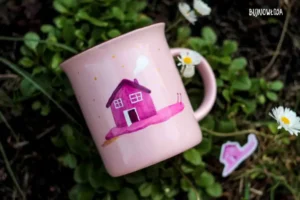
Hi! I started my adventure with hand-painted mugs with ceramic - it’s the classic and a natural starting point. Over time I discovered that the ceramic paints I use work great on other materials too. Today I also paint on glass and enamel vessels. Each of these materials is resistant to high temperature, isn’t damaged during firing, and the paint bonds with the smooth surface. I’ll show you how these mugs differ from one another and whom I recommend each for.
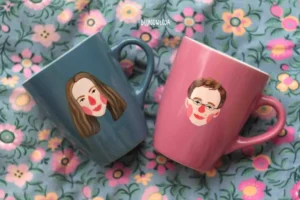
A ceramic mug - the classic that always works
Ceramic is the most classic material for mugs - and probably the most common choice in my orders. In shops you’ll find masses of models: different sizes, shapes, colours. From classic plain cylinders to slightly conical forms, from capacious mugs for a big coffee to tiny espresso cups.
Painting on coloured mugs is more of a challenge for me than on white ones, because my paints are slightly transparent - the base colour shows through the illustration. But that’s not a problem, just something to plan for - I choose the pattern’s colour scheme so it harmonises with the mug’s hue and the whole thing is cohesive. On a dark green mug a portrait lays out differently than on white, but that doesn’t rule it out - it just requires thought.
I recommend a ceramic mug to those who drink their beverage slowly - because it’s the material that holds heat longest. A morning coffee, an afternoon tea, an evening infusion - ceramic keeps the temperature longer than glass or thin enamel, which matters practically for many people.
Other strengths of ceramic:
- Solidity - well-fired ceramic is genuinely durable, takes everyday wear
- Versatility - fits any interior style: classic, modern, Scandinavian
- Availability of models - I have access to dozens of different shapes, I can match the client’s preferences
- Thermal stability - after firing the paint bonds with the surface without a problem
Ceramic is also the most common choice as a gift for older people, for couples, for parents. It’s the “classic mug” that surprises not with the material but with the illustration. If you don’t know what to choose - ceramic is a safe, tried-and-tested direction.
A glass mug - patterns that levitate in the drink
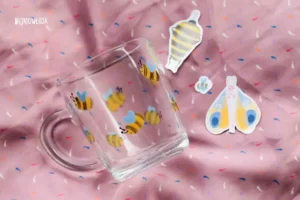
Glass is a very rewarding material, because it’s transparent. Patterns painted on a glass mug seem to float in the air, becoming part of the surroundings rather than of the mug itself. Looking through the glass at the illustration and the vessel’s contents gives an interesting visual effect - water distorts the painted elements and sets them in motion.
As a child I played with this effect - I imagined the illustrations “bathing” in the drink, submerging, rising, rippling. From an adult perspective I see that a glass mug has its own aesthetic, one you can’t replicate on ceramic. The colour of the drink becomes the background for the illustration - a pale tea, a strong coffee, an intense raspberry juice - each gives a different backdrop and a different mood.
I recommend such a mug as a gift for people who like to show off the colour of their drink - lovers of herbal teas, juices, infusions with an interesting colour. Someone who drinks greenish yerba mate, fiery-red rooibos, colourful infusions - on a glass mug they’ll see that whole palette and have a daily aesthetic pleasure.
When glass doesn’t work best:
- For people who drink slowly - glass loses heat faster than ceramic
- For clumsy people - glass mugs are more prone to breaking (though good, thick glass is quite resistant)
- In kitchens with children - here ceramic, or especially enamel, is better
A glass mug with a portrait is also an interesting effect - the figure “floats” in the drink as you sip. Some clients deliberately choose this material for portraits, because it adds a light, ethereal character to the illustration.
An enamel mug - lightness, travel, vintage
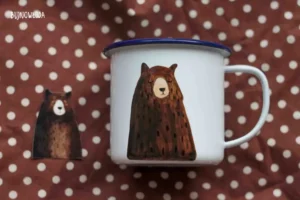
Recently I’ve also been painting on classic white enamel mugs. It’s a vessel that’s coming back into favour and growing more popular, but still feels original - because for a long time it was used for cooking rather than drinking. Today the enamel mug is a synonym for vintage, Provençal, traveller style.
The advantages of enamel are concrete:
- It can be used as a pot - an enamel mug withstands heating over a fire, over a camp stove, on the road
- It’s much lighter than ceramic and glass - a practical difference, especially when you carry the mug in a backpack
- It works great for travel - it doesn’t break, doesn’t weigh much, takes knocks
- A retro character - the aesthetic of enamel carries associations with old kitchens, camping, a simple lifestyle
- Easy to wash - enamel is smooth and doesn’t absorb smells or stains
I recommend an enamel mug to lovers of the mountains, camping, rustic vibes. It also suits kitchens furnished in vintage or Provençal style. It’s a gift for someone who likes the outdoors, travel, a café style “without metropolitan pretensions”.
From a painter’s perspective enamel has one great advantage - its characteristic cylindrical shape, which makes composition easier. No tapering, no complicated forms - just a simple cylinder that gives an evenly spread surface for the illustration. For portraits of animals in their full silhouette (like horses, cats, slim dogs) it’s often the best choice.
Which to choose - a short decision guide
In short: ceramic - the classic and the drink’s heat. Glass - the visual effect and the display of colour. Enamel - lightness, travel and a rustic character. Each of these mugs can be hand-painted, each is suitable as a gift and each can be fully personalized.
Helpful questions worth asking yourself before choosing:
- What style is the recipient’s home furnished in? Classic and elegant - ceramic. Vintage or Provençal - enamel. Modern and minimalist - both will work.
- What does this person most like to drink? Long coffees and teas - ceramic. Colourful infusions and juices - glass. Strong black coffee on the move - enamel.
- Does the recipient travel a lot or like the outdoors? Yes - enamel. No - ceramic or glass.
- What’s the character of the gift? Classic, “for the ages” - ceramic. With an artistic accent - glass. With character, non-standard - enamel.
- The recipient’s age? Older people often prefer ceramic. Younger ones - happily experiment with enamel. Glass is a choice for anyone with refined aesthetic taste.
The most-ordered variants are a portrait of a loved one or a pet - you can compare this format with my custom illustrated portraits in the paper version. Some clients combine formats - a paper portrait in a frame for the living room plus a mug for everyday use.
What all three materials have in common
Whatever material you choose, the creative process is similar. Each project starts with a brief - your guidelines, reference photos, a description of the recipient. Then a digital design comes about, which I show you for approval. After your “OK” I transfer the sketch onto the mug and paint it in layers, with specialist high-temperature paints. Firing at 150 degrees fixes the paint, quality control confirms everything is as it should be, and I pack the mug for shipping.
All my mugs - ceramic, glass, enamel - are waterproof after firing. All are suitable for everyday use. All I encourage washing by hand to extend the life of the painting. And all are one of a kind, because it’s handcraft, not assembly-line production.
If you’re hesitating over the choice of material - just write and describe who and what occasion the mug is for. I’ll advise which material will work best in your situation.
Concrete examples from my studio
To show how differently the various materials look in practice, I’ll tell you about a few real orders.
A ceramic mug for grandmother’s name day - a classic white mug, grandmother’s portrait en face, her name by hand with a brush below the portrait. A muted palette, warm tones. Ceramic gives this project the solidity and classic beauty that suits an older recipient.
A glass mug for a tea enthusiast - transparent glass, a composition with a floral motif, a sprig of mint entering the silhouette of a woman drinking from the mug. The effect: when the client pours tea, the illustration “bathes” in the drink.
An enamel mug for a travelling couple - white enamel with portraits of two figures, a walkie-talkie, a backpack, a characteristic mountain motif as a background. A material perfectly suited to the theme, light, made for travel.
A set of three mugs for a family - mum, dad and child, each on a separate mug, but all in one style. All ceramic, to keep consistency. Each mug with the owner’s name.
A glass mug with a maritime motif - for someone fascinated by sailing. Blue and azure accents, a ship on the horizon, small waves. Glass suits the “watery” motif, giving a light, transparent effect.
These examples show that the material isn’t a neutral backdrop - it’s part of the design, it affects how the illustration works visually and emotionally.
Practical differences in care
Each material needs a slightly different approach in everyday use. In short:
- Ceramic - hand washing, sponge, mild liquid. Avoid sudden temperature changes.
- Glass - the same, plus be careful with knocks. Glass is tougher than it seems, but even thick glass can break under a hard blow.
- Enamel - the most resistant to knocks, but don’t use metal spoons to stir (they can leave scratches on the painting over time). Hand washing, sponge.
In all cases I recommend hand washing, even though the mugs have been fired and are waterproof. The dishwasher can weaken the colours over the long run - better to let the mug live longer.
Want to order a mug? Write to me - I reply within 48 hours.
More in painted mugs
All painted mugs →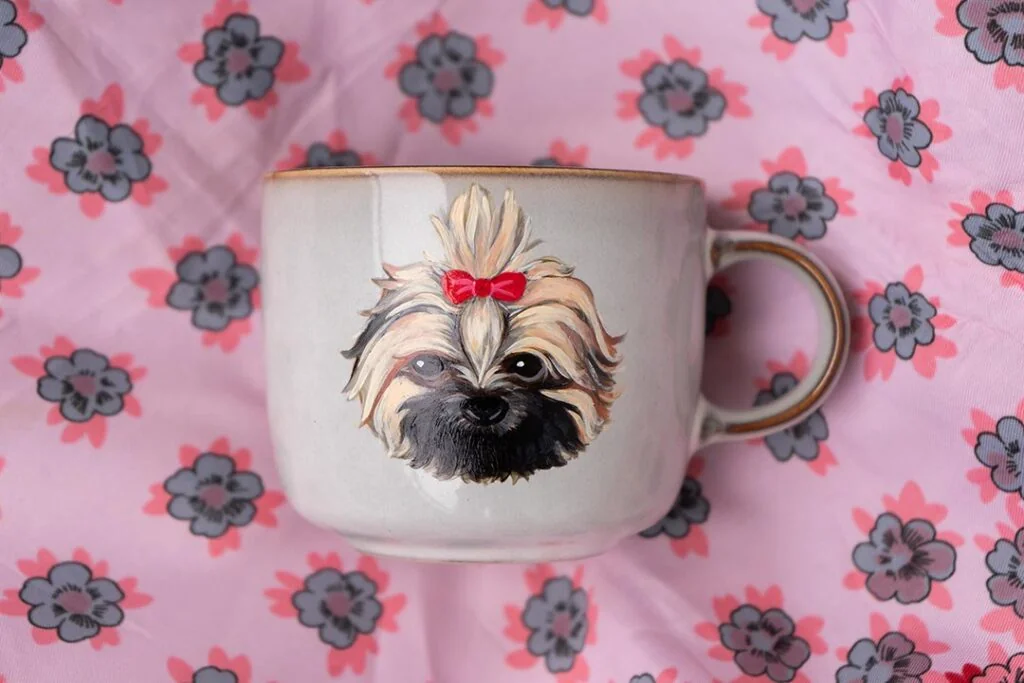
Painted mugs
A personalized mug with a dog - how it's made
How I work on a hand-painted mug with a dog's portrait - from reference photos, through capturing the pet's character, to extra elements and lettering.
Painted mugs
An original wedding gift
Hand-painted wedding mugs with portraits of the newlyweds as an original, personal wedding gift. Practical and sentimental at the same time.
Painted mugs
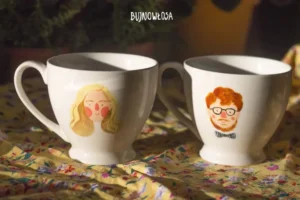
How are hand-painted mugs made?
The whole process of making a hand-painted mug - from the digital design, through transferring the sketch, painting with ceramic paints, to firing and quality control.
Start a project
Got a project? Let's talk.
I make art that stays - with emotion and attention in every project. Children's book illustration delivered worldwide, wedding and B2B event live painting across Poland - every project starts the same way: an inquiry, a conversation, a decision. Write to me directly. The Bujnowłosa studio is me and a decade-plus of practice.