
Painted mugs · 9 min read
How are hand-painted mugs made?
The whole process of making a hand-painted mug - from the digital design, through transferring the sketch, painting with ceramic paints, to firing and quality control.
· Anna Karwala
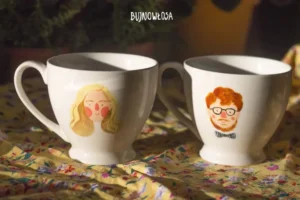
Painting ceramic is a specific technique with its own rules - different from digital drawing or working on paper. I’ll show you how a mug is made in my studio, using the example of a couple’s portrait I did recently. It’s work for the patient - mistakes on ceramic are very hard to undo, so I treat each stage as a checkpoint at which I can still change, refine, correct something.
The design stage - it all begins digitally
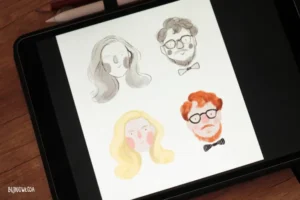
A personalized hand-painted mug needs a well-thought-out start. Mistakes on ceramic are very hard to undo, so I draw the whole design digitally first. This way I can freely correct proportions, composition and details before I ever touch the mug with a brush.
With portraits each person is a different challenge. I take into account not only the colour and length of the hair, but the shape of the face, the proportion of nose to mouth, the character of the gaze, the fine traits that define the likeness. In the illustrative style simplification is unavoidable - the portrait isn’t photorealistic, but that’s exactly why the choice of which features to emphasise is crucial.
Before I move to execution, I always show the design to the client and together we decide whether everything works. It’s the moment when you get a last chance to change the proportions, add an element, correct the hair colour or ask for a slightly different facial expression. I’d rather sort all this out in a digital file than argue over a finished but not-quite-right mug.
The digital stage also includes the choice of composition - whether the figure will be in the centre or to the side, whether it’ll span the whole circumference of the mug or stay on one side only. All of this depends on the mug’s shape, but also on how many elements have to fit.
Transferring the sketch onto the mug
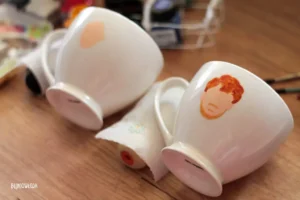
I rescale the approved design to the mug’s dimensions and transfer the composition onto the ceramic surface using a tracing technique. I use a pencil to draw the contours delicately - it’s a kind of “base” for the actual painting. The pencil marks are later covered by paint or can be gently washed off with water if they stray outside the painted line.
This isn’t a stage that looks impressive from the outside - a barely visible mesh of lines appears on the mug. But it’s the foundation of the whole project. If the lines are well laid out at this stage, the further work is much easier and more precise. If something is under-developed, paint won’t fix it.
I work calmly then, without rush, checking the proportions on every curved surface - a ceramic mug isn’t a flat sheet, so the composition has to work on a cylinder, not on a plane. This requires constantly rotating the mug and checking the perspective from different sides.
Painting - slowly, in layers, with patience
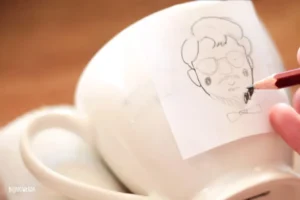
The ceramic paints I use behave a little like acrylic watercolours - before drying they’re water-soluble, after drying they’re resistant. The hardest thing: the paint slides on the smooth ceramic surface. You have to paint slowly, precisely and lay down several layers so the colour is saturated and even.
It’s a stage that requires focus. Here the design on the screen turns into a real, physical object. Every stroke of the brush is a decision I won’t undo with Ctrl+Z. Music in the background, good light, the mug on a special stand or in my hand - and dot by dot, line by line, the figure starts to materialise.
The paints are slightly transparent, so successive layers build depth and saturation. The first layer is delicate, almost like a watercolour glaze. The second is already more vivid. The third closes the colour. The details - lines, accents, contours - I add last, once the base of the composition is already set.
The working time on one mug is usually a few hours of pure painting, spread over several days. It’s not a job done in one go. Between layers the paint has to dry. In the meantime I often go back to the digital design, check whether some detail needs correcting, plan the next stage.
Firing - the moment the design becomes permanent
The finished mug goes into the kiln. The firing fixes the paint permanently, smooths the surface and makes the illustration waterproof. After firing the mug withstands hot water and gentle washing - it can be used normally.
The firing temperature for the paints I use is about 150 degrees. It’s a crucial stage - only after the kiln are the colours stable, the paint bonds with the ceramic surface and can no longer be wiped off. Before firing the whole design is still “soft” and needs careful handling. After firing - it’s a finished product.
The paint maker doesn’t recommend the dishwasher, but in my own tests the mugs pass this exam too. Nonetheless I advise hand washing - it extends the life of the painting and treats it with the respect due to a thing painted personally for you.
Quality control and shipping
I check every mug for water resistance before packing. If something raises my doubts, the mug goes back for correction. Sometimes it happens that some small element didn’t fix perfectly - then I repaint it and repeat the firing. Better to extend the process than to send something that starts to discolour after the first wash.
After a positive test I wash the mug by hand in warm water, dry it, pack it in bubble wrap and a cardboard box. I add a short care note - because I know not everyone knows that hand-painted ceramic shouldn’t go in the dishwasher. The more gently you handle it, the longer it stays with you.
I take packaging seriously - it’s the last stage, after which the mug leaves my hands. If the parcel is crushed in transit, all the earlier work goes to waste. That’s why I pack with plenty of protection to spare, even if the box seems “too big” for the contents.
Who this gift is for
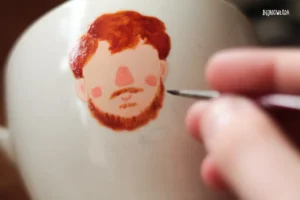
A hand-painted mug works great as a gift for a couple, for a family, for close friends - for anyone who’ll appreciate a thing that’s practical and personal at the same time. Each piece is different, made in a single copy, with a specific person in mind.
Clients most often order mugs for occasions with emotional weight: a wedding, a jubilee, Mother’s Day, Grandmother’s Day, a round or unusual birthday. But I also get commissions with no occasion - someone simply wants to bring a loved one joy, to give something that won’t appear in any chain store.
If you want a portrait of a specific person on a mug, take a look at the offer of custom illustrated portraits - the same craft goes onto paper and onto ceramic. Some clients combine formats: they order a portrait in the paper version for framing and the same motif on a mug, for everyday use. It works great as a comprehensive gift.
Why this process makes sense
One might ask: why so many stages, when today you can take a photo, print it on a mug by sublimation and have a “personalized mug” in 24 hours? The answer is simple - they’re two different things. Print is reproduction. Painting is interpretation.
A hand-painted mug has the line. It has small imperfections that are proof that someone sat down and painted it especially for you. It has a style - my style, which you can see in my portfolio and judge whether it suits you. It’s a thing you pass down, not one you throw away after two years.
That’s why the whole process takes time. Digital design, tracing, layers of paint, firing, check, packaging. Each of these stages matters and each contributes to what you get in the end.
What affects the turnaround
The typical time from order to shipping is two to three weeks. Here’s what makes up that time:
- The initial conversation and refining the brief - a few days, depending on how quickly we exchange messages
- The digital design - usually two to three days from the moment I have all the information
- Approval on your side - here the time depends on you and on whether you need revisions
- The actual painting - a few hours of work spread over three to four days, because the layers have to dry
- Firing - one day in the kiln, then cooling
- Quality control and packaging - a day
- Courier shipping - two to three working days within Poland
In seasonal periods (pre-holiday, before Grandmother’s Day, in the wedding season) the time may be longer, because I have more simultaneous orders. It’s best to write sooner rather than later.
How to care for a hand-painted mug
After buying, it’s worth knowing a few things about care. The paint maker doesn’t recommend the dishwasher. In my own tests the mugs go through the dishwasher without damage, but I don’t guarantee it for every cycle and every detergent. I advise hand washing - with a soft sponge, a mild liquid.
Don’t use scourers, rough brushes, abrasive powders. The paint surface is smooth, but strong friction can weaken it over time. If the mug is heavily soiled, it’s best to soak it in warm water with a little liquid, then wipe it.
Avoid sudden temperature changes - don’t pour boiling water into a heavily chilled mug or vice versa. It’s a general recommendation for ceramic and it applies to painted mugs too.
Treated this way, a mug lasts for years. I have pieces of mine from five years ago - the colours are still vivid, the painting clear, the mug looks like new.
Want to order a mug? Write to me - I reply within 48 hours.
More in painted mugs
All painted mugs →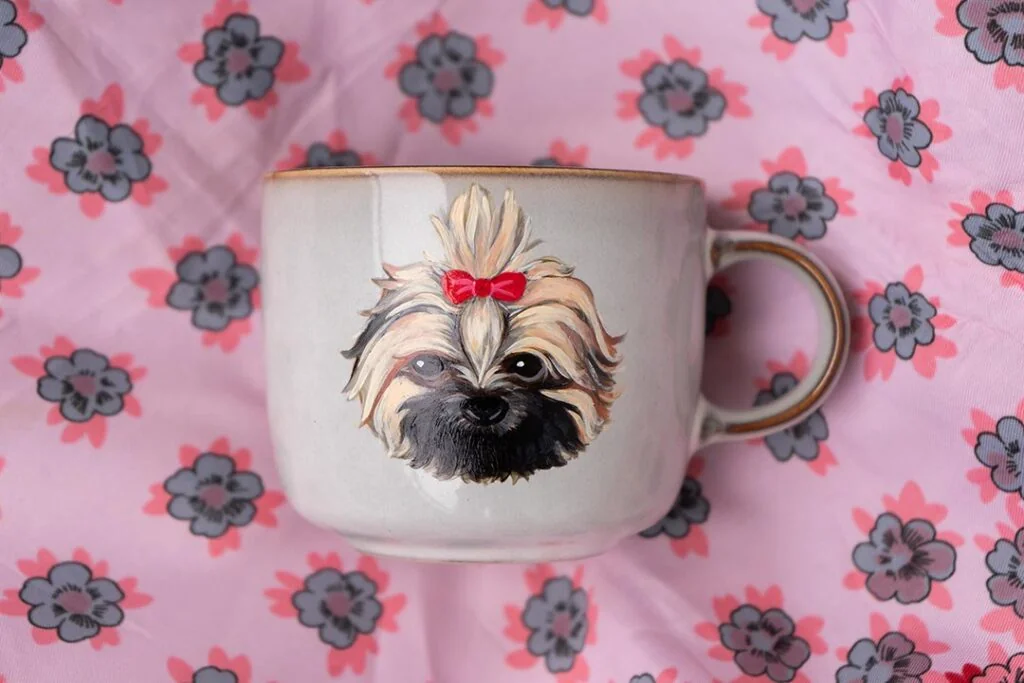
Painted mugs
A personalized mug with a dog - how it's made
How I work on a hand-painted mug with a dog's portrait - from reference photos, through capturing the pet's character, to extra elements and lettering.
Painted mugs
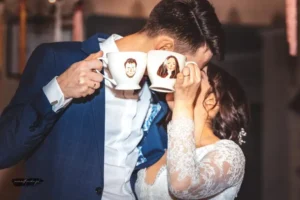
An original wedding gift
Hand-painted wedding mugs with portraits of the newlyweds as an original, personal wedding gift. Practical and sentimental at the same time.
Painted mugs
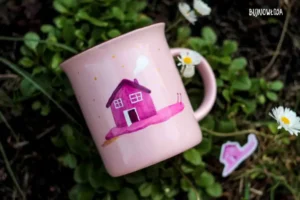
Types of hand-painted mugs
The three materials I paint on: ceramic, glass and enamel. How they differ, who each is best for, and how they affect the end result.
Start a project
Got a project? Let's talk.
I make art that stays - with emotion and attention in every project. Children's book illustration delivered worldwide, wedding and B2B event live painting across Poland - every project starts the same way: an inquiry, a conversation, a decision. Write to me directly. The Bujnowłosa studio is me and a decade-plus of practice.